- Ekochamber
- Posts
- Crypto’s Quiet Architect: How Paradigm is Building the Future, Line by Line
Crypto’s Quiet Architect: How Paradigm is Building the Future, Line by Line
Your Daily Eko
🧠 Insights You Won’t Forget
Today's insights are inspired by my reading of Colossus Review on Paradigm (crypto focused fund founded by Matt Huang)
Paradigm’s model: Venture firm meets R&D lab
Paradigm blends deep research, engineering, and venture capital, enabling it not just to fund companies but actively invent core infrastructure like Uniswap v3 and Blend. This model positions it as both a creator and investor in crypto’s most fundamental layers.
Long-term conviction, not just capital
From aggressively buying Bitcoin at $4K in 2018 to backing open-source infrastructure without proprietary control, Paradigm plays a decades-long game. They optimize for long-term protocol success rather than short-term returns, betting on crypto’s inevitable maturity.
Crypto’s three-phase evolution framework
Huang outlines a compelling mental model:
• Stage 1: Money (e.g. Bitcoin, stablecoins)
• Stage 2: Financial System (DeFi, tokenized assets)
• Stage 3: Internet Platform (decentralized social, gaming)
This frames crypto not as a product but as an evolving ecosystem, similar to the internet’s rise.
Bullseye liquidity: A leap in capital efficiency
Paradigm researchers invented a new way to concentrate liquidity in stablecoin markets. This allows far more efficient trades and reduced fragmentation, yet they openly publish such innovations for others to use, reinforcing their ecosystem-first philosophy.
Failure, reflection, and cultural resets
Paradigm’s FTX loss ($278M) and OpenSea overvaluation became hard-earned lessons. Rather than retreat, they downsized, tightened standards, and reinforced alignment with crypto’s long-term vision, turning adversity into cultural recalibration.
Unconventional talent strategy: Bet on mutants
They consistently recruit atypical genius: MIT dropouts, Discord pseudonyms, gaming obsessives. What matters is potential, not pedigree. The Paradigm Fellowship and early-stage scouting reflect this philosophy of finding future outliers early.
Open-source as a compounding advantage
With tools like Foundry (used by 90% of the industry) and Reth (10x faster Ethereum node), Paradigm gives away its technical edge. In doing so, it attracts top engineers, accelerates innovation, and deepens its influence over the crypto stack.
Founder alignment > optics or hype
Huang’s major regret in the FTX debacle wasn’t just the fraud, it was backing someone who didn’t share their vision for crypto’s future. Paradigm now filters investments through a strict lens of values and ecosystem alignment.
Strategic humility in AI vs. crypto
Despite AI’s massive momentum, Huang chose not to pivot Paradigm, believing crypto still lacks champions. His view: “AI will be fine without us, crypto won’t.” That clarity protects focus amid trend-chasing.
Mission-driven resilience through bear markets
Paradigm sees down cycles as healthy filters. As prices collapse, noise clears, revealing signal-rich builders. They treat these periods not with fear but as times of opportunity and deep work.
Recall from last week
The Venture Capital System Is Inherently Misaligned
No stakeholder, GPs, LPs, founders, has an incentive to accurately mark down asset values, creating distorted valuations and “zombie unicorns” that persist despite lacking real growth or exits. This fosters a self-reinforcing illusion of value across the ecosystem.
Consumer AI Is Likely an Under Appreciated Opportunity
Most AI investment has focused on enterprise use cases, but Gurley suggests consumer AI, especially with advancements in memory and voice, could spawn breakout products. The US is behind China here, indicating a possible contrarian play.
💡 Eko Worth Remembering
“Things people tell you are hard usually aren’t. They’re only hard because you don’t have agency over your tools.”
⚡ Active Recall – Test Yourself
Question: Why did Paradigm open-source its most powerful research like bullseye liquidity and Foundry, and how does that approach influence its competitive positioning?
🛤️ Off the Record
Sat in my favorite coffee shop for a few hours this weekend and dived into Issue 2 of the Colossus Review. Being crypto myself for five years I know a fair bit, but still learned a ton from their deep dive on Matt and Paradigm.
I knew Paradigm was a good VC, but I did not fully understand just how good. Matt is an n of 1 person himself, and somehow convinced many other n of 1 people to join him. One interesting point about Paradigm comes from their technical excellence. A main contributor to that is Georgios Konstantopoulos who has shipped some of the most important parts of the ecosystem to date in an open-source manner: Foundry (a tool that checks smart contracts to avoid bugs that can lead to exploits), and Reth (taking only 18 months to complete, and resulted in optimizing Ethereum’s core node software allowing for innovations like Base and Optimism).
Despite Paradigm being caught up in the FTX situation, they have continue to identify and back many good founders who I hope are pushing the industry int he right direction, not just a cash grab. I deeply appreciate Matt’s dedication to trying to do the right thing by the industry. It because of firms like Paradigm we are where we are, and these leaders will help push us forward to where we want to be.
Another concept that made me think was when I read “what if Sequoia founded Google instead of investing in it?” Imagine a VC that ships code so good the VC is the product. It would flip the entire venture model on its head. It would completely change the way VC’s are seen. Based off last weeks Eko, we learned from Bill Gurley that
“The Venture Capital System Is Inherently Misaligned: No stakeholder, GPs, LPs, founders, has an incentive to accurately mark down asset values, creating distorted valuations and “zombie unicorns” that persist despite lacking real growth or exits. This fosters a self-reinforcing illusion of value across the ecosystem.”
A VC that builds real products, marks its own homework, and forces the rest of the industry to compete on execution rather than paper marks, that might be the reset we need to unlock the next wave of innovation.
Eko’s Top Pods
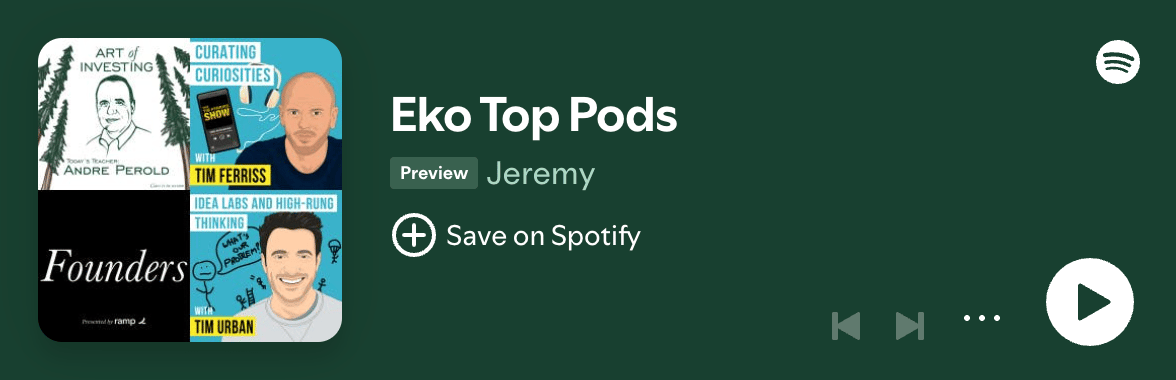
Reply with an episode suggestion. If added, you’ll get a shoutout from Eko!
Answer:
Paradigm believes building the ecosystem accelerates its own impact and attracts top talent. Open-sourcing builds goodwill, legitimacy, and network effects, giving Paradigm long-term leverage even when others implement their research.
Enjoyed these insights? Forward this newsletter to a friend. Let’s grow smarter, together.
Reply