- Ekochamber
- Posts
- Eko Weekly Round-Up 7/25/25
Eko Weekly Round-Up 7/25/25
You listened. You learned. You forgot. But don’t worry, Eko remembered for you. Here are your daily top insights to keep you sharp.
🧠 Insights You Won’t Forget
Today's insights are compiled from the past week!
Fear of Losing Fueled Unrelenting Drive
Del Vecchio never rested, driven by fear that someone better would take what he built. This fear, born from poverty and orphanhood, powered six decades of empire building and a $25B fortune.
Work Was Worship, Family Came Second
His dedication to Luxottica eclipsed personal life. Four marriages, six children, and one regret he didn’t believe: “not spending more time with my kids.” He led from the front, factory floor first, office last.
Simple Ideas, Brutal Execution
“If I can make the best frames, why let someone else assemble them?” His decisions were guided by clarity and ruthless follow-through: acquire the customer touchpoint, destroy inefficiencies, own everything.
The FDIC’s ‘Least Cost’ Mandate Doesn’t Prevent Bailouts
The legal requirement to resolve failed banks at “least cost” often incentivizes bailing out uninsured deposits because when a bank is 90% uninsured, covering only insured depositors doesn’t significantly reduce costs, creating systemic moral hazard.
Unseen Consolidation Risk: Flight to ‘Too Big to Fail’ Banks
SVB’s failure triggered massive capital flows from regional to mega banks, reinforcing the perception that only big banks are safe. This leads to market concentration, unfair cost-of-capital advantages, and fewer lending sources for small businesses.
Buy Now, Pay Later (BNPL) = Blind Spot in Credit System
BNPL is surging, growing 10x during COVID, but isn’t tracked on credit reports, making it invisible to lenders and regulators. Consumers are unknowingly over-leveraging, and systemic risk is mounting unmeasured.
Ambition can coexist with joy
Contrary to Silicon Valley’s obsession with “tortured greatness,” Kelly proves that ambitious, impactful work can be done with levity, playfulness, and genuine satisfaction. His benchmark isn’t shareholder value or burnout; it’s: “Did I have a good day today?”.
“Greatness is overrated”
Kelly challenges the cult of obsession and martyrdom often seen in high achievers. He sees greatness as a form of extremism, often accompanied by undesirable traits, citing Steve Jobs and Bob Dylan as examples.
💡 Eko Worth Remembering
test quote here
🛤️ Off the Record
Happy Friday, hope you had a killer week and are ready for the weekend!
I want to jump back to the July 17th Eko on Sixth Street as I could not shake this idea after a founders event I attended on Wednesday where I talked to a lot of VCs.
Back in 2016, when Spotify was still privately wrestling with giants like Apple and Amazon, most investors saw a fragile business model under pressure. Sixth Street saw a liquidity challenge paired with a generational founder and great unit economics, and wrote a $1B convertible deal that ended up compounding hard.
The brilliance wasn’t just in the underwriting. It was in how they were structurally set up to do it. No bloated growth fund scrambling to write checks. No approval gridlock. Just the ability to move with speed, flexibility, and alignment. Why? Because they had quietly built TAO, a $30B+ fund that sits on top of their core funds like a synthetic Goldman Sachs balance sheet. It lets them size deals to opportunity, not to fundraising pressure.
That’s the theme I can’t stop thinking about this week: architecture as strategy. Everyone talks about having flexible capital. Very few actually design for it. Sixth Street didn’t just stumble into adaptability, they engineered it by refusing to let fund size dictate behavior. In a world where so many GPs drift from their original playbook in pursuit of “scale,” this stands out as a real discipline advantage.
The deeper lesson here isn’t just about investing. It’s about designing systems that keep you honest. You can claim to be an investor-first firm, but unless your architecture supports that identity, pressure will push you somewhere else. If you want to stay nimble, you have to build optionality into your structure, not just your rhetoric.
I think about this even outside finance. Great founders design their org charts, incentives, and culture to support the kind of company they want to be 10 years from now. Most people just optimize for what they need right now. That’s a tactical decision, but rarely a strategic one.
So this week, I’m asking myself: where have I outgrown the structure I originally set up? Where am I pretending to be flexible, but actually boxed in? And what could I re-architect, now, that future me will thank me for?
Sixth Street didn’t get lucky with Spotify or Airbnb. They trained for it. They built for it. And when the world went sideways, they didn’t flinch. They faced the tiger.
Eko’s Top Pods
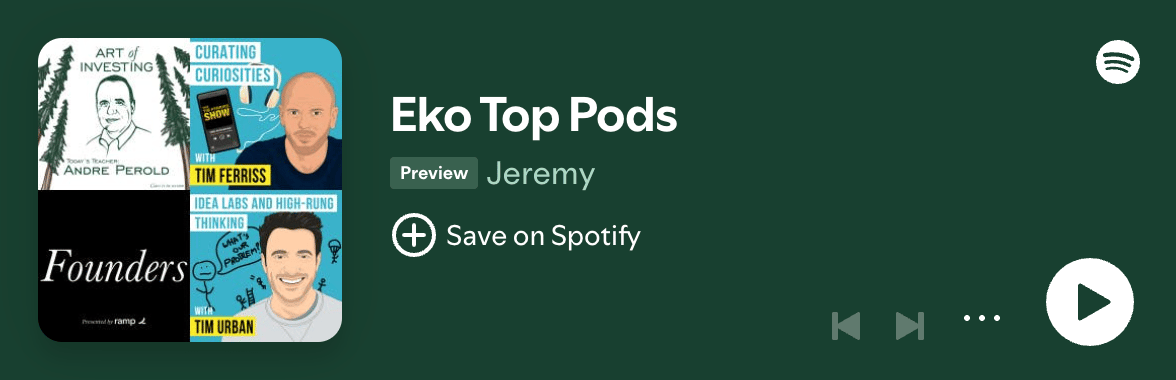
Reply with an episode suggestion. If added, you’ll get a shoutout from Eko!
Enjoyed these insights? Forward this newsletter to a friend. Let’s grow smarter, together.
Reply