- Ekochamber
- Posts
- How to Build an Empire
How to Build an Empire
Your Daily Eko
🧠 Insights You Won’t Forget
Today's insights are inspired by a recent episode of Founders on the Founder of Luxottica
Relentless Vertical Integration Built an Empire
Leonardo Del Vecchio’s genius lay in controlling every part of the value chain: from manufacturing tiny metal parts, to designing, producing, distributing, and retailing glasses. This obsession with vertical integration enabled unmatched efficiency, profit margins, and brand power.
Excellence as a Non-Negotiable Standard
Del Vecchio’s lifelong principle was simple: “I want to be the best at everything I do.” He believed perfection wasn’t an ideal, it was a standard. This manifested in everything from product design to store cleanliness to supplier quality.
M&A as a Predator’s Tool, Not a Partner’s Strategy
Luxottica’s method: acquire, analyze, eliminate outside suppliers, and dominate the shelf. His takeovers of LensCrafters, Oakley, and others show a ruthless playbook, strike fast, control distribution, and vertically integrate.
Eyewear as Fashion, Not Function
His insight to reposition glasses from medical necessity to fashion accessory changed consumer behavior and margins. The 1988 Armani licensing deal catalyzed a luxury strategy that later saw Ray-Ban turn from gas station brand to $2B icon.
The Essilor Merger: Control Disguised as Partnership
Del Vecchio merged with lens giant Essilor in a “50-50” deal, but structured it so he’d control the entity within three years. This move unified frames and lenses, completing his vision of total optical dominance.
Fear of Losing Fueled Unrelenting Drive
Del Vecchio never rested, driven by fear that someone better would take what he built. This fear, born from poverty and orphanhood, powered six decades of empire building and a $25B fortune.
Work Was Worship, Family Came Second
His dedication to Luxottica eclipsed personal life. Four marriages, six children, and one regret he didn’t believe: “not spending more time with my kids.” He led from the front, factory floor first, office last.
Simple Ideas, Brutal Execution
“If I can make the best frames, why let someone else assemble them?” His decisions were guided by clarity and ruthless follow-through: acquire the customer touchpoint, destroy inefficiencies, own everything.
Use Debt Like Rockefeller, Bet Big
With confidence in product quality and market insight, he repeatedly used leverage to buy competitors much larger than himself (e.g., US Shoe/LensCrafters), justifying the risk through disciplined post-deal integration.
Founders Should Never Step Down
Like Sam Walton, Del Vecchio learned stepping away doesn’t work when your identity is fused with the company. He returned from retirement, ousted his successor, and sealed his legacy by merging with Essilor.
Recall from last week
Sell with honesty, not bluster
Embrace your smallness instead of pretending to be bigger. Clients value transparency, speed, directness, and not dealing with bloated processes. It’s refreshing and memorable in a sea of over-polished agencies.
Fast follow-ups win deals
Sending a clear, point-form summary email the same day after a sales call (“What I Heard”) shows attention to detail and builds immediate trust. Bonus: it lets you correct misunderstandings before they become issues.
💡 Eko Worth Remembering
“I want to be the best at everything I do. That is all.”
⚡ Active Recall – Test Yourself
Question: How did Del Vecchio’s approach to vertical integration give Luxottica a sustained competitive advantage, and what risks or limitations might such a strategy carry for founders today?
Eko’s Top Pods
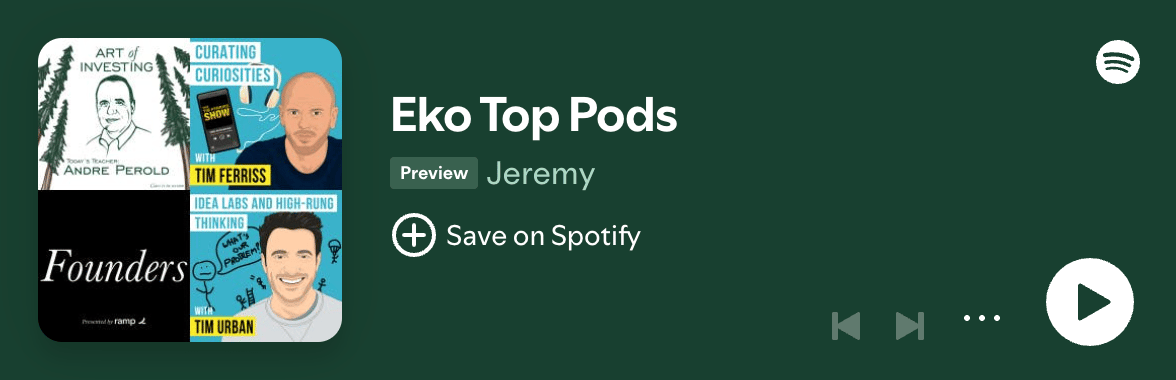
Reply with an episode suggestion. If added, you’ll get a shoutout from Eko!
Answer:
Advantage: speed to market, high margins, brand control, pricing power, reduced dependency.
• Risks: high capital intensity, complexity, cultural resistance during M&A, founder dependence on operational scale.
Enjoyed these insights? Forward this newsletter to a friend. Let’s grow smarter, together.
Reply