- Ekochamber
- Posts
- Is Malleable Software Taking Over?
Is Malleable Software Taking Over?
Your Daily Eko
🧠 Insights You Won’t Forget
Today's insights are inspired by a recent episode of Dialectic w/ Geoffrey Litt
Malleable software restores user agency
Geoffrey Litt argues that most modern software feels like “sealed boxes,” limiting users’ ability to adapt tools to their specific needs. His vision: digital tools should evolve with us, like a “leather shoe” molding to its wearer, not force us to conform to rigid interfaces.
The ‘nightmare bicycle’ critique of intuitive design
Litt draws from Andy diSessa’s metaphor of a bicycle with opaque, mode-based gear switches (e.g., “gravel mode,” “uphill mode”). It critiques software that obscures internal logic. Users need visible seams and transparent systems to build real understanding and creativity.
Software should be more like Legos, not avocado slicers
Apps today are like “avocado slicers”, single-use tools designed with narrow assumptions. Instead, Litt advocates for software with modularity and reusability, enabling users to tweak or repurpose parts the way we remix Lego bricks.
Local developers are the missing middle
Litt champions the rise of “local developers”, non-engineers like power spreadsheet users who tailor tools for their communities. These empowered intermediaries can bridge the gap between rigid software and contextual needs without becoming full-time programmers.
AI expands malleability, if we have access
While LLMs lower the barrier to tool creation, they don’t help unless the software is “open kitchen” rather than “food court.” AI’s true power is realized only when users have control over their environment and can meaningfully integrate generated tools into their workflow.
Design for a smooth slope of complexity
Litt emphasizes a design principle: allow users to go from beginner to expert gradually, like moving from sticky notes to wall demolition in a home. Software should not have cliffs of complexity where the next step suddenly demands learning to code.
Creative tools should allow for virtuosity
Drawing inspiration from musical instruments and chef’s knives, Litt insists that serious creative tools must support mastery. Tools should not just simplify, they should deepen capability and enable excellence for those who invest the time.
The power of tinkerers building for themselves
Litt’s story of building a personal AI butler with Telegram + SQLite + cron jobs shows the potential of personalized automation. It wasn’t polished but delivered real utility. He calls for environments where people can incrementally “vibe-code” their lives.
From ‘file vs app’ to environments over applications
Echoing thinkers like Steph Ango and Robin Sloan, Litt proposes unbundling apps into composable environments. Think of software more like a kitchen (space) and chef’s tools (functions), instead of prepackaged meals with no flexibility.
Culture and tools shape agency, so choose wisely
Litt warns of learned helplessness in digital life. Locked-down systems teach passivity. He advocates for environments, especially in education and tech, that reinforce a belief in personal agency and the right to reshape one’s tools and surroundings.
Recall from last week
Search Funds as Life’s Work Launchpads
Thorndike positions search funds not as exit-driven tools, but as platforms for ambitious early-career CEOs to build enduring businesses. With heavy board mentorship and low-risk, high-ownership paths, they are “forced savings programs” that convert youth and grit into multi-generational wealth and purpose.
Contrarian Ownership and League Model
Instead of independent owners, Cole owns all teams, allowing mission alignment, quality control, and experimentation. This counters conventional league structures and enables innovations like consistent ticket pricing and K Club membership benefits.
💡 Eko Worth Remembering
“Customizing software in this way is an uphill battle because the tools and infrastructure that we use to develop and deploy software treat users as passive recipients rather than active co-creators.”
⚡ Active Recall – Test Yourself
Question: How does Geoffrey Litt’s concept of “local developers” challenge traditional software development models, and what implications does it have for how organizations should design digital tools for teams?
🛤️ Off the Record
So this was not about robots, like I mentioned in the round-up, as I did not have time to read the entire article this weekend. Instead I got outside, got a little sunburnt, and ate a lot of food. I mean a lot.
What I did do this weekend is listen to Jackson, the host of Dialectic, talk to Geoffrey. The kitchen knife metaphor really clicked for me, not just because it’s vivid, but because it nails the tension between modularity and embedded constraints. At Ekochamber, I’m trying to bring that same philosophy of flexible, swappable parts into how users interact with their own learning stack. I wish they had unpacked Ink & Switch more, it feels like a lab built for high-agency thinkers, and that model deserves more airtime.
To learn more about Malleable Software.
Some new AI tools I played with this weekend:
https://aurachat.io/ : got to flex the design muscle a bit here and see how easy it is to make some animations (time to rebuild Eko to get a better UI/UX…sorry)
https://www.figma.com/make/ : Heard a lot of mixed things, as it is in Beta but I really enjoyed using this. I think this might become the most powerful AI tool but they need to work a bit on stability and their UX for it. Its close, just not there yet.
Eko’s Top Pods
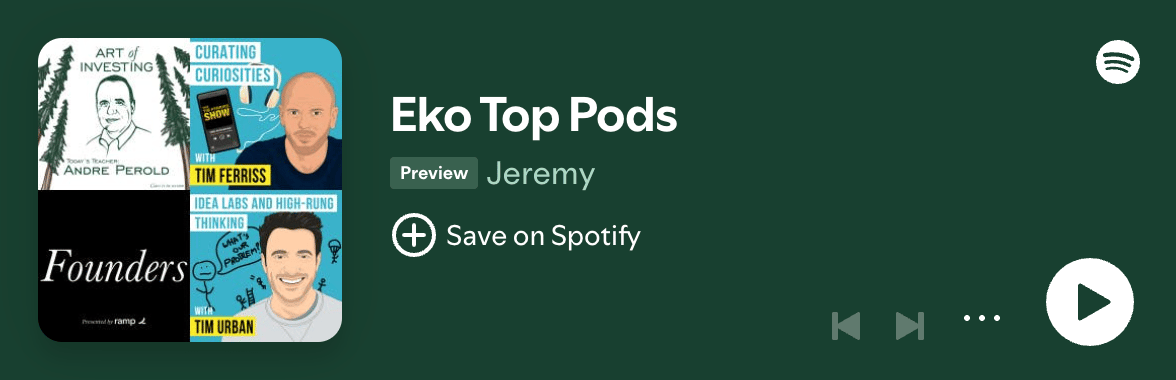
Reply with an episode suggestion. If added, you’ll get a shoutout from Eko!
Answer:
Geoffrey Litt’s concept of “local developers” challenges the traditional top-down model by empowering everyday users, like the Excel expert in an office, to customize and evolve tools based on deep contextual knowledge. This shifts the role of developers from sole creators to enablers, building platforms that invite end-user modification. For organizations, it means designing software that is transparent, modular, and easily tweakable to support grassroots innovation and adaptability within teams.
Enjoyed these insights? Forward this newsletter to a friend. Let’s grow smarter, together.
Reply