- Ekochamber
- Posts
- Noodle to Google
Noodle to Google
Your Daily Eko
🧠 Insights You Won’t Forget
Today's insights are inspired by a recent episode of Acquired about Google
Google’s real genius wasn’t PageRank, it was their infrastructure
Beyond search quality, what made Google unbeatable was their custom infrastructure: commodity hardware, distributed file systems (GFS), and innovations like MapReduce. These let them scale faster and cheaper than anyone else, making the business insanely high-margin and nearly impossible to replicate.
The magic flywheel: more queries = better ads = more revenue = more distribution
Google realized search was a winner-take-all market. More searches meant more advertiser demand, which meant higher prices per click, which let them pay more for distribution, which got them even more searches. This feedback loop was the engine of Google’s dominance.
They won by being aggressive in distribution, not just superior in product
Google paid software companies, OEMs, and even gave revenue shares up to 100% just to get Google Toolbar or default search set. Toolbar installs increased usage 7x. This wasn’t passive virality, it was aggressive, relentless acquisition.
Their monetization breakthrough wasn’t ads, it was AdWords + AdRank
Google borrowed the pay-per-click model from Overture but improved it by adding a relevance score (click-through rate), creating AdRank. This led to better user experience and more revenue, high-quality ads surfaced naturally, and bad ads got buried even if they paid more.
Google nearly sold to Yahoo for $1 billion, and again for $3 billion
Multiple acquisition offers from Yahoo were rejected. In hindsight, those moments represent the last chance incumbents had to stop Google. By the time Yahoo offered $3B, Google’s counter was $5B, a reverse acquisition in spirit.
AdSense was a second, hidden business line built in six weeks
Jeff Dean built AdSense, which matched ads to content (not just queries). It instantly generated $1M/day and opened a huge new monetization channel publishing. It also seeded the playbook for monetizing YouTube later.
AOL deal: Google bet the company and it paid off
In 2002, Google guaranteed AOL $100M in search ad revenue they didn’t have yet. Sergey said, “If we can’t monetize the pages, we deserve to go out of business.” The deal worked and trained millions of users to associate “search” with Google.
Google’s IPO changed tech financing forever
They insisted on a Dutch auction to avoid insider games and used a dual-class structure to maintain founder control. Both moves were contrarian at the time and both are now Silicon Valley norms.
Search economics: revenue per user increases as you scale
In most businesses, costs go down with scale. In search, revenue also goes up, more bidders per keyword and more obscure queries monetized. This meant Google could always outbid competitors for user acquisition.
Recall from last week
The attention economy is a spiritual war
Attention is not a passive asset but the construction material of our reality. Where we place our attention determines which ideas shape us, making attention hygiene essential to individual and collective agency.
The modern internet has Balkanized into “memetic Galapagos”
We’ve moved from a public “global village” to siloed, overlapping group chats. While this offers safety from information overload, Nadia warns that excessive isolation may breed distorted idea ecosystems that lack external challenge.
💡 Eko Worth Remembering
“We should be able to monetize the pages. If not, we deserve to go out of business.”
⚡ Active Recall – Test Yourself
Question: Why did Google’s decision to prioritize infrastructure early on give them a defensible moat, and how did this connect to their eventual dominance in advertising?
🛤️ Off the Record
Happy Monday friends, writing from the big apple this week. I am very excited to the Acquired team live at radio city music hall Tuesday night. The Off the Record section on Friday will have my thoughts and reflections from that event!
A question that I have been noodling the past week is, ‘what are my true goals and what lifestyle do I want to have?’ What factors of my life am I trying to maximize for? Freedom, relationships, fun, learning, brain rot?
The solution I have come to currently is a mix of all the above. I want to have strong relationships, while also having freedom in my daily activities, and most importantly I do want to have fun. The next step for me is to decide what that fun actually looks like. Is it conventional fun or something else? I am not to sure.
What are you currently trying to maximize for in your life? let me know!
Eko’s Top Pods
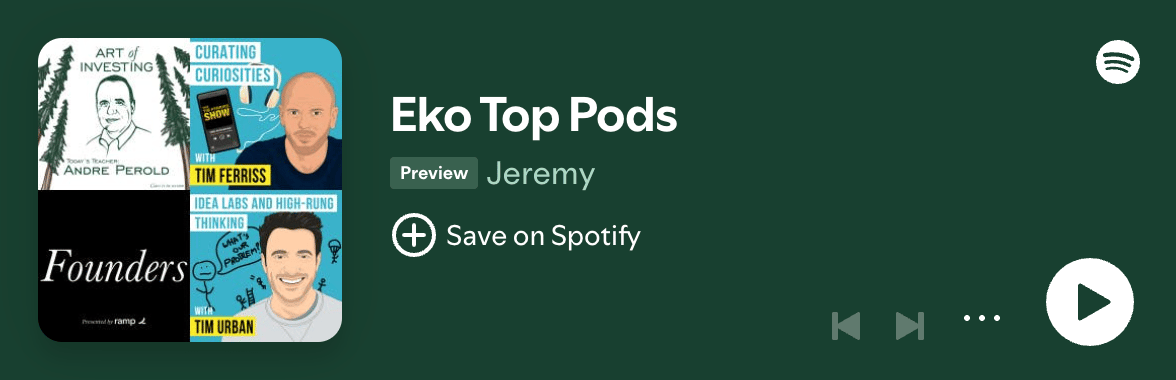
Reply with an episode suggestion. If added, you’ll get a shoutout from Eko!
Answer:
Because their infrastructure (cheap, distributed systems) let them scale cheaply, they could deliver better search and more ad inventory faster. This enabled rapid growth in advertiser demand, user experience, and margin. It also made it nearly impossible for slower, hardware-dependent competitors to catch up.
Enjoyed these insights? Forward this newsletter to a friend. Let’s grow smarter, together.
Reply