- Ekochamber
- Posts
- Performance During Pain
Performance During Pain
Your Daily Eko

🧠 Insights You Won’t Forget
Today's insights are inspired by a recent episode of Invest Like the Best w/Mark Bertolini.
Servant Leadership as a Turnaround Engine
Mark Bertolini’s philosophy of helping ordinary people do extraordinary things drove Aetna’s transformation. By prioritizing employee welfare (wage increases, free healthcare for lower-income staff, mindfulness programs), he created a mission-driven culture that doubled shareholder returns and sparked a 652% TSR during his tenure.
Eliminate Employer-Sponsored Insurance for Personalization & Cost Control
Bertolini argues the U.S. healthcare system’s biggest structural flaw is employer-sponsored insurance. His vision: shift to defined contributions where individuals choose plans tailored to their needs, creating price sensitivity, personalization, and risk-spreading efficiency.
AI and Curiosity as Core Leadership Tools
He emphasizes that executives need “curiosity and courage.” Curiosity drives continual learning and updating mental models; courage means acting without perfect information. This philosophy parallels his use of AI at Oscar Health, deploying dozens of LLMs to cut costs, scale insights, and empower patients.
Narrow Networks as a Strategic Advantage
Contrary to conventional wisdom, smaller, narrower provider networks are more cost-efficient than large networks. By letting individuals select plans that fit their doctors and conditions, Oscar leverages efficiency while improving member satisfaction.
Radical End-of-Life Innovation at Aetna
Bertolini changed hospice rules so patients didn’t need to “give up hope” to enter care. Hospice adoption rose from 18% to 75%, costs fell by 75%, and families reported better final experiences. This demonstrates how removing structural barriers can unlock humane and financially sustainable outcomes.
Neuroplastic Pain & Business Resilience
After 18 years of crippling pain, Bertolini discovered he had “neuroplastic pain” rather than intractable pain. Through CBT, TMS, and VR retraining, he rewired his brain. The revelation underscores how unrecognized systemic issues, whether in health or business, can persist until reframed with the right diagnosis.
No Margin, No Mission
A lesson from Catholic health leadership: sustainable impact requires profitability. Bertolini insists that both nonprofits and for-profits must generate margins to fund mission growth, reframing profit not as greed but as fuel for service.
Iconoclasm as Competitive Advantage
Quoting Machiavelli, Bertolini embraces living “in the dangerous space” of disrupting entrenched systems. His iconoclasm, challenging healthcare’s orthodoxy and corporate norms, has been the consistent driver of his leadership successes.
Recall from last week
Party History as Regime Survival Strategy
Xi Jinping’s push for party history education is central to his goal of making the CCP “immortal,” using revolutionary narratives as moral education to bind members’ loyalty and legitimacy.
Why People Joined the CCP Despite the Risks
Early members often joined not out of ideological sophistication but because communism provided meaning, agency, and a sense of urgency during national crisis, plus, for some, social allure and romantic opportunities.
💡 Eko Worth Remembering
“Never waste a good crisis. The challenges that could break you are really gifts, because they make you a better person.”
⚡ Active Recall – Test Yourself
Question: If U.S. healthcare shifted from employer-sponsored insurance to an individual choice-based system, what structural and behavioral changes would be required for both employees and providers, and what parallels can you draw to defined contribution pensions?
🛤️ Off the Record
free write section/ads
Eko’s Top Pods
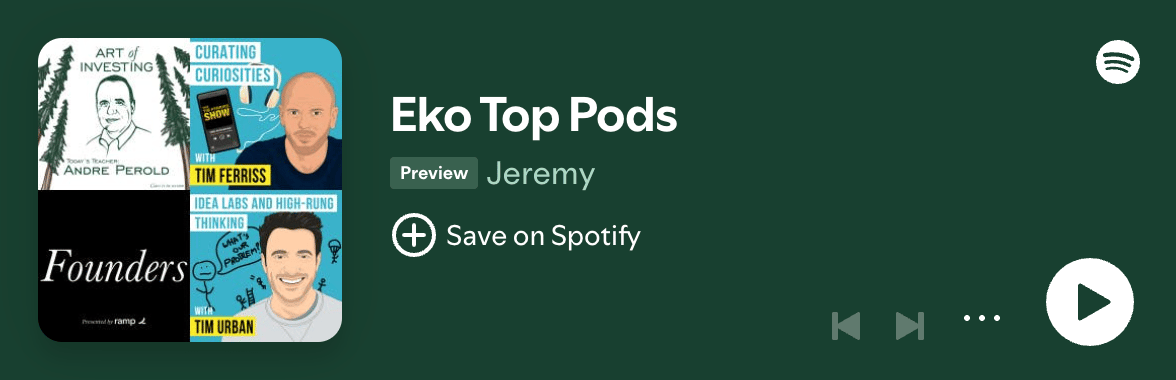
Reply with an episode suggestion. If added, you’ll get a shoutout from Eko!
Answer:
Employees would need education and broker-like guidance to choose plans aligned with their personal needs, just as financial advisors help with pensions. Providers and insurers would need to adapt to narrower networks and personalized benefits, while risk pooling across larger populations would stabilize costs. The parallel is the shift from a one-size-fits-all group model to a personalized, responsibility-driven marketplace.
Enjoyed these insights? Forward this newsletter to a friend. Let’s grow smarter, together.
Reply