- Ekochamber
- Posts
- what the BOOM
what the BOOM
Your Daily Eko

🧠 Insights You Won’t Forget
Today's insights are inspired by a recent episode of Odd Lots with BOOM
Concorde’s failure was not technological but structural
The Concorde’s demise was due to its origins in Cold War-era central planning, not a lack of demand or tech. It was a government-driven prestige project that ignored economic realities like seat pricing and market size, an expensive mistake that killed supersonic travel prematurely.
Regulatory own goals have stalled US innovation
The 1973 US ban on overland supersonic flight froze the development of the sector for decades, blocking natural innovation cycles that typically bring down costs and expand markets.
Boom Supersonic’s strategy: start with premium flyers, scale down cost
Boom targets business and first-class travelers with a 64-seat, $5,000-per-ticket model, about a quarter the cost of the Concorde, built for transoceanic flights first. The model aligns with where airlines make 80% of their profits.
The speed dividend changes airline economics
Supersonic jets offer faster asset utilization: the same aircraft and crew can run twice the number of flights in a day, effectively reducing per-flight costs and increasing profitability despite higher speed.
Capital efficiency and vertical integration are key unlocks
Boom is achieving a 5–6x cost reduction vs. legacy aerospace players through tight vertical integration, in-house part production, and software-led rapid iteration cycles. For example, they bypassed a $1M turbine blade quote by purchasing a $2M printer to make them in-house.
Talent strategy: the “oak and spirits” model
Boom hires 80% young, driven talent and 20% seasoned experts to create a dynamic learning environment that promotes fast problem-solving over institutional inertia. Engineers from big firms often fail in this setup due to rigidity.
Supersonic passenger preferences mirror subsonic behavior
On 3–4 hour domestic flights, passengers don’t demand flatbeds, they care about time, convenience, and connectivity. Supersonic jets match that flight duration profile, which means people will value speed over lie-flat beds for transatlantic trips.
FAA trust = faster progress
Boom’s proactive, transparent collaboration with the FAA, modeled on 1990s Boeing practices, resulted in an R&D flight approval in 90 minutes vs. the usual 90 days. Avoiding delegated oversight and engaging early builds trust and avoids late-stage rework.
US aerospace supply chains are broken by politics
The US defense-driven, geographically dispersed supply chain is a product of congressional lobbying, not efficiency. It slows production and inflates costs, unlike centralized Chinese manufacturing or vertically integrated private firms like SpaceX.
Key tech improvements enabling viable supersonics
Composite materials, modern engines without afterburners, advanced alloys, and AI-enhanced virtual design tools (vs. slow wind tunnel testing) create 20% gains in both aerodynamic and engine efficiency, making supersonic jets feasible and economic today.
Recall from last week
2008 Crisis: Complexity Without Transparency Is Fragile
What broke the financial system in 2008 wasn’t derivatives alone, but the opacity, misjudged AAA ratings, and concentration of risk in entities like AIG. Instruments that were meant to diversify risk ended up reconcentrating it through hidden structures.
Three Predictive Lenses for Future Crises
Tett offers a powerful framework:
• Look for overcorrections from past regulation
• Watch for social silences, what isn’t being talked about
• Investigate siloed systems where cross-cutting risks fall through institutional gaps
💡 Eko Worth Remembering
“Both optimists and pessimists contribute to our society. The optimist invents the airplane and the pessimist the parachute.”
⚡ Active Recall – Test Yourself
Question: Why did the Concorde fail commercially, and how is Boom Supersonic’s approach structurally different in addressing both market demand and regulatory barriers?
🛤️ Off the Record
Happy Matcha Monday! Flying back home today so the weekend was packed with to many logistical things. Deeper section later this week (Friday probably!)
Here is what the inside of the Concorde looked like:
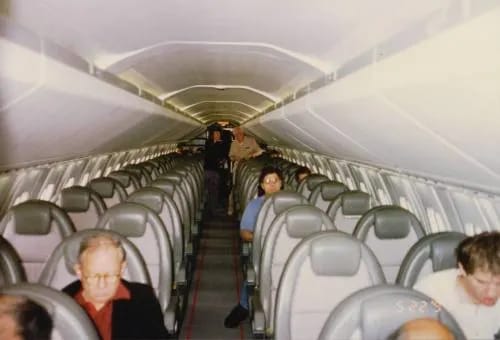
kinda not great…
Eko’s Top Pods

Reply with an episode suggestion. If added, you’ll get a shoutout from Eko!
Answer:
Concorde was centrally planned and economically unviable: only 100 narrow, uncomfortable seats priced at ~$20,000 could not attract sufficient volume in the ’70s/’80s.
Boom is targeting premium business travelers with ~$5,000 fares, scaling from a transoceanic, 64-seat aircraft.
Boom avoids regulatory pitfalls by working with the FAA proactively and focuses on private sector-led production without government planning distortions.
Enjoyed these insights? Forward this newsletter to a friend. Let’s grow smarter, together.
Reply