- Ekochamber
- Posts
- Wisdom hacks: Tom Morgan's energy compass for life's complexity 🧭🚀
Wisdom hacks: Tom Morgan's energy compass for life's complexity 🧭🚀
Your Daily Eko
🧠 Insights You Won’t Forget
Today's insights are inspired by a recent episode of Dialectic w/ Tom Morgan
Follow the Energy, Not the Plan
Tom Morgan’s central heuristic for navigating life is tracking what gives and drains energy. This “energy diary” approach functions as a compass for authentic alignment and decision-making. Rather than forcing goals, observe what excites or depletes you daily, and incrementally orient toward the former.
Complexity = Differentiation + Integration
Morgan draws on complexity theory to argue that personal growth is not just about becoming unique (differentiation), but also about staying connected to the whole (integration). Overemphasizing uniqueness leads to dissociation; real resilience lies in harmonizing individuality with systemic coherence.
Syntropy as a Guiding Force
Introducing the lesser-known concept of “syntropy” (a future-oriented counter to entropy), Morgan suggests that love, curiosity, and emergence may be signs of an evolutionary pull toward integration. This is a compelling framework for understanding inner drives and systemic patterns alike.
Minimum Viable Woo
Morgan walks the line between mysticism and pragmatism, using what he calls “minimum viable woo” to introduce fringe ideas to skeptical audiences. The key is whether a belief or experience leads to behavioral change, rather than its scientific pedigree.
Walled Gardens for Personal Reinvention
He strongly advocates for “walled gardens”, safe, contained spaces where people can run tiny experiments in self-discovery and career pivots. These experiments are designed to reduce existential risk while increasing self-knowledge.
Right Brain as Master, Left as Emissary
Echoing Iain McGilchrist’s thesis, Morgan emphasizes the imbalance of modern society: too much left-brain (abstract, reductive) thinking and not enough right-brain (holistic, embodied) integration. Wisdom and creativity flourish when the right brain leads and the left assists.
Synchronicity as Feedback Loop
Rather than dismissing synchronicities as random, Morgan interprets them as the environment’s feedback mechanism, signs that you’re in alignment with deeper currents of emergence and integration.
Positive-Sum Games as Lifestyle Design
He structures his daily life around activities that are “positive-sum” (benefiting everyone involved): reading, jiu-jitsu, writing, conversations. This framing elevates relationships and routines into systems of mutual nourishment and avoids burnout.
“Earth School” as Existential Frame
Morgan proposes a reincarnation-based model of life: each person is here to learn pre-selected lessons. This “Earth School” lens reframes suffering as curriculum and personal growth as the ultimate telos of life.
Faith as Experimental Openness
Rather than dogmatic belief, faith is seen as the willingness to act without proof and look for feedback. This incremental model of faith resembles startup iteration: take action, look for signs, adjust accordingly.
Recall from last week
The “Power of Choice” and Strategic Intentionality
Weaver preaches that most people live unconsciously. His executive framework is built around stepping back, asking bold questions (e.g., “What would you do if you knew you couldn’t fail?”), and designing life/career from deep intuition.
The N.I.C.K. Method for Event Success
A simple framework for hosting high-quality events:
• Name tags: unify attendees and break cliques.
• Intros: short round-robin to break ice and reset conversations.
• Cocktails/mocktails only: avoid sit-down meals which kill mingling.
• Kick them out: end on a high note to preserve energy and anticipation.
💡 Eko Worth Remembering
“Follow your bliss, and doors will open where there were only walls.”
⚡ Active Recall – Test Yourself
Question: Tom Morgan introduces the concept of “syntropy” as a counterpart to entropy. How might syntropy reframe your understanding of motivation, curiosity, or personal growth, especially in contrast to goal-setting rooted purely in rational planning?
🛤️ Off the Record
Happy Monday!
Yet again Jackson, the host of Dialectic, comes out with another fire episode. I really appreciate the intense background research and thoughtful questions he asks his guests. We are early to his podcast, and I think it will be the next one to really blow up and go mainstream.
As you read above, this episode is packed with thought-provoking ideas. Insight 8 really stuck with me this weekend as I sat down to write. In a world that often nudges us toward competition and self-interest, choosing to think in positive-sum terms — where your actions benefit both you and those around you — feels like a powerful shift.
It also reminded me of the value of being fully present. Giving your attention, without distraction, to the people and moments in front of you is a quiet form of generosity. Sometimes, it’s not the action itself that matters most, but the intention behind it.
Small shifts, big impact.
To keep tabs on Tom check out his newsletter: https://newsletter.theleading-edge.org/
Eko’s Top Pods
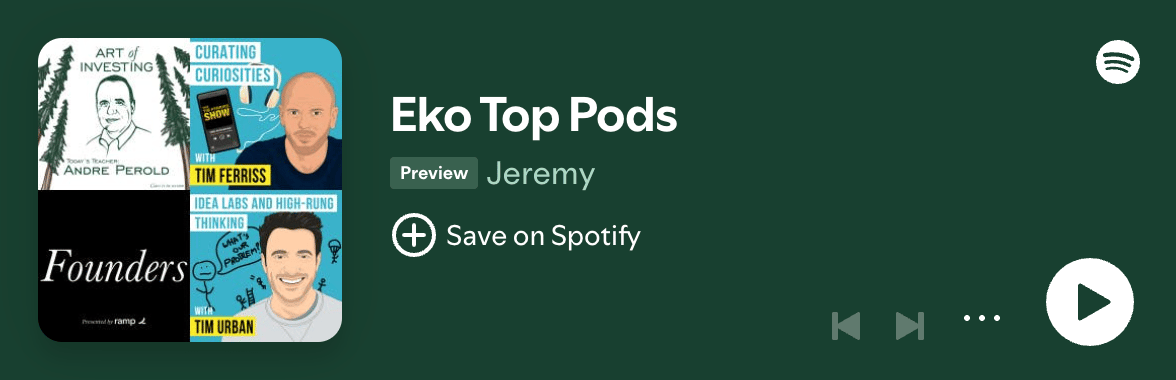
Reply with an episode suggestion. If added, you’ll get a shoutout from Eko!
Answer:
Syntropy reframes motivation and personal growth as a pull from the future rather than a push from the past. Instead of setting goals based solely on rational planning (which often uses left-brain logic and external expectations), syntropy suggests that there’s an emergent force drawing us toward integration, love, and wholeness, a kind of evolutionary attractor.
So, rather than asking “What should I do next?” based on logic, we ask, “What am I being pulled toward with energy, curiosity, and love?” This perspective encourages trusting inner signals, excitement, synchronicity, flow, as indicators of alignment with a deeper systemic intelligence.
Enjoyed these insights? Forward this newsletter to a friend. Let’s grow smarter, together.
Reply