- Ekochamber
- Posts
- Your Daily Eko
Your Daily Eko
Forgotten podcast gold: Monish Pabrai's secrets to turning $1 into $100 🚀🧠
🧠 Insights You Won’t Forget
Today's insights are inspired by a recent episode of My First Million w/ Monish Pabrai
Berkshire Hathaway as Default Index + Opportunistic Bets
Treat Berkshire Hathaway as your long-term compounding base (10% annual return = 128x over 49 years). Overlay this with rare, asymmetric bets when obvious anomalies arise, this combination gives you a path to a 100x return.
Look for ‘2x4 to the Head’ Investments
The best investment opportunities feel absurdly obvious once discovered “too good to be true,” strange, or deeply mispriced. Examples: Frontline, Japanese trading houses, Titan. These are rare but career-defining.
Risk ≠ Uncertainty
Huge opportunities exist when Wall Street confuses risk and uncertainty. Frontline was deeply uncertain but not risky due to non-recourse debt and salvageable asset value. Seek low-risk, high-uncertainty setups.
Be One Inch Wide, One Mile Deep
Mastery and conviction come from depth, not breadth. Like John Arrillaga (real estate) or Sam Walton (retail), know your niche better than anyone and ignore distractions.
Simplify Until a 10-Year-Old Understands
If you need Excel to explain your thesis, pass. Simple, clear investment cases are not only more durable but increase conviction. Use second-order thinking: And then what?
Value Investors Club as a Modern-Day Moody’s Manual
Use curated platforms like VIC for daily idea flow. Read 4–5 writeups/day and dig deeper when something feels off (in a good way). Great ideas are time-insensitive.
Humility + “Too Hard Pile” = Success
Adopt Buffett’s physical “Too Hard” pile. 99% of ideas should go there. Focus your energy only on understandable, analyzable businesses. This is a humility-based edge.
Play Long Games You’re Wired For
Use your temperament and owner’s manual to guide your path. Pabrai’s success came from realizing he’s a single-player game guy and designing his investing life accordingly.
Extreme ROI in Philanthropy Mirrors Investing Principles
Pabrai cloned a high-ROI nonprofit model focused on IIT entrance for underprivileged youth. His approach: treat giving like investing, measure inputs/outputs, optimize, and compound social impact.
Compounding + Early Start = 8,000x
Starting young with steady 10% returns and a 90-year runway leads to astronomical results (8,000x+). A small amount early is exponentially more valuable than larger amounts later.
💡 Eko Worth Remembering
“You should be able to explain your thesis of a stock in about four or five sentences to a 10-year-old.”
⚡ Active Recall – Test Yourself
Question: If an investment opportunity looks uncertain but has low downside risk and high asset value, how would you distinguish it from a risky investment? (ex. the Frontline situation Monish talked abt).
🛤️ Off the Record
Happy Monday! I hope you enjoyed the weekend and were able to relax a bit even with the all the commotion in the world. All eyes are on the markets this morning seeing if the 500 point upward move holds in market open.
Unlike Monish, I did not figure out a way to beat a casino, but I did figure out a RAG model pipeline for Eko. Huge shoutout to my friend who showed me what I was doing wrong!
Most people never build meaningful wealth or mastery, not because they lack intelligence or opportunity, but because they treat focus like a tactic instead of a moral choice. Real focus means choosing one small corner of the world to care deeply about, going a mile deep while everyone else skims the surface. It’s not flashy, but it compounds. And over time, that quiet conviction outperforms any hack, model, or trend.
In a culture that rewards breadth and speed, choosing depth and slowness is subversive. It requires believing that knowing less, but caring more, can be a winning strategy. Focus isn’t just about productivity. It’s a statement of values. A refusal to be distracted. A belief that mastery is still possible in a world that keeps telling us otherwise.
Eko’s Top Pods
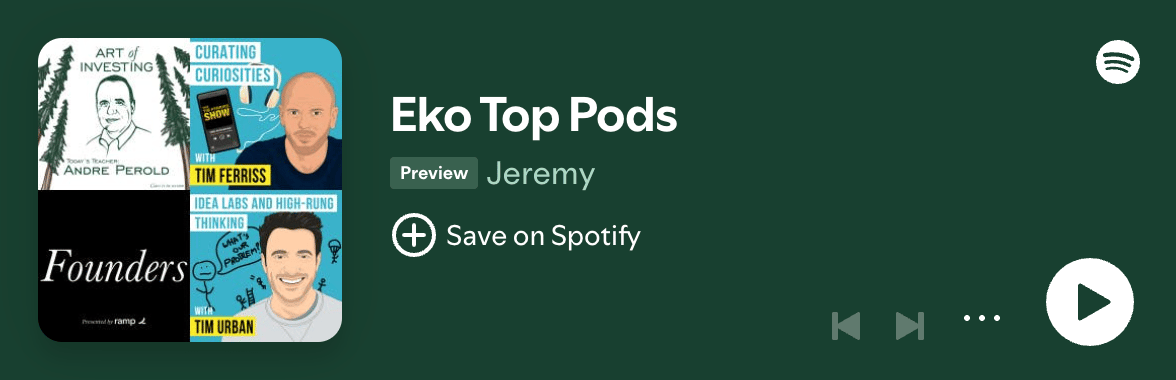
Reply with an episode suggestion. If added, you’ll get a shoutout from Eko!
Answer: Frontline was highly uncertain due to market conditions but had non-recourse debt and hard asset value. The downside was capped — it was uncertain when it would recover, not if. Risk implies permanent capital loss; uncertainty implies delayed resolution.
Enjoyed these insights? Forward this newsletter to a friend. Let’s grow smarter, together.
Reply