- Ekochamber
- Posts
- Your Daily Eko
Your Daily Eko
Buffett's secret sauce: Mental models that turn complexity into clarity 🧠🚀

🧠 Insights You Won’t Forget
Today's insights are inspired by recent episodes of Founders hosted by David Senra
Invert, Always Invert
Charlie Munger’s most repeated mental model is inversion: solve problems by figuring out what not to do. “I saw good judgment mostly by collecting instances of bad judgment.” Buffett adds, “You start out with failure and then engineer its removal.”
Default to Simplicity
“Avoiding problems is better than solving them.” Both Buffett and Munger are obsessed with simplicity: keep decisions, models, and strategies clear and timeless. They cut through noise and complexity to act on obvious truths.
Survival > Maximization
Buffett and Munger design systems that can withstand inevitable mistakes. “Play like a champion today” becomes “Remember your helmet.” Their business philosophy: don’t get killed. “Life snaps you at your weakest link.”
Schedule Time to Think
“Most people schedule themselves like dentists.” Buffett and Munger insist on unscheduled time daily to read, think, and reflect. This discipline allows them to make high-quality decisions infrequently but with high impact.
Avoid Leverage, Value Liquidity
Buffett warns: “Leverage often produces zeros, even when used by smart people.” They prioritize financial strength, hold vast cash reserves, and operate to never be a forced seller. “Cash is like oxygen—you only notice it when it’s gone.”
Only Work with A-Players (and Avoid Mediocrity)
“There are too many .240 hitters in business.” Buffett stresses avoiding B or C players and low-integrity people. They bet heavily on talent, often acquiring companies solely because of exceptional operators.
Be Rational When Others Aren’t
“We do not read other people’s opinions. We get the facts, and then we think.” They consciously mute external noise and resist groupthink, focusing on independent analysis and decisions.
Tailwinds Beat Talent
Buffett learned this from his painful textile investment: even great managers can’t fix bad economics. Seek businesses with natural tailwinds and avoid those with chronic headwinds, regardless of operational excellence.
Unusual Discipline Is the Edge
Buffett defines their advantage as “unusual managerial discipline,” especially when others are being irrational (e.g., underwriting unprofitable insurance just to maintain volume).
Avoid Envy, Not Just Greed
Munger’s insight: “The world isn’t driven by greed, it’s driven by envy.” Recognizing and resisting envy improves decision-making, peace of mind, and long-term orientation.
Recall from last week
here
here
💡 Eko Worth Remembering
“Everything that needs to be said has already been said. But since no one was listening, everything must be said again.”
⚡ Active Recall – Test Yourself
Question: Buffett and Munger argue that surviving bad decisions is more important than maximizing gains from good ones. What specific financial strategies or business principles do they use to build antifragility into Berkshire Hathaway’s structure, and how might these apply to startups or small businesses?
🛤️ Off the Record
With the recent news of Warren Buffett officially stepping down, it felt only fitting to kick this week off with a deep dive into the man who defined modern investing. Buffett’s career is nothing short of historic. From taking over a struggling textile company in 1965 to transforming it into a multibillion-dollar conglomerate, his long-term performance remains unmatched. Alongside Charlie Munger, he turned simplicity, discipline, and integrity into a wealth-building machine, compounding capital at nearly 20 percent annually for decades. Few careers offer such a clear and durable blueprint for success built on patience, clarity of thought, and relentless focus.
One of Buffett’s most underrated lessons is not about finance but about time. He and Munger designed their lives to protect long stretches of uninterrupted thinking. In a world obsessed with busyness and noise, Buffett reminds us that deep, unhurried thought is a secret weapon. If you can carve out that time for yourself, even just thirty minutes, you will be surprised by how much clarity and insight you can uncover. As Buffett often reminded us, compounding is the eighth wonder of the world. It applies not just to money, but also to the accumulation of wisdom over a lifetime. This is why I am building Eko, I want to to build a modern tool to unlock the compounding effect for us.
Eko’s Top Pods
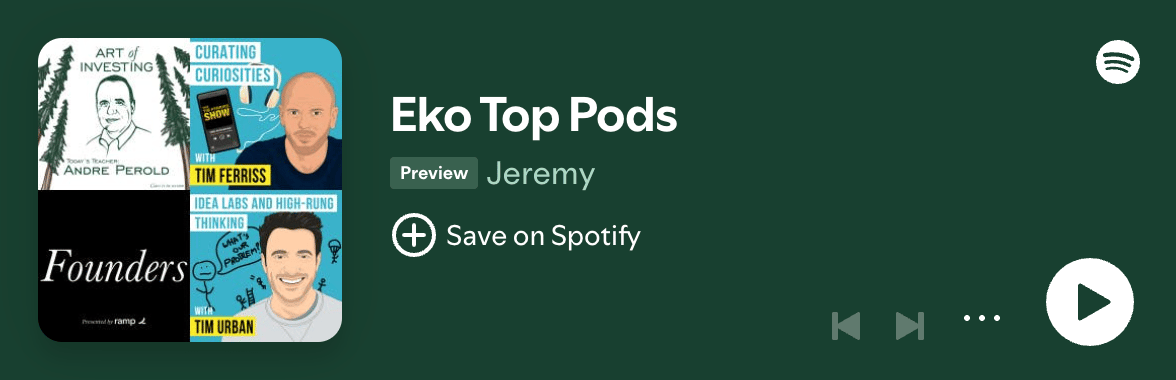
Reply with an episode suggestion. If added, you’ll get a shoutout from Eko!
Answer: Building cash reserves, avoiding leverage, decentralizing operations but centralizing capital allocation, investing in tailwind businesses, staying within one’s circle of competence
Enjoyed these insights? Forward this newsletter to a friend. Let’s grow smarter, together.
Reply